
Vistry has warned that the industry’s growing skills shortage is risking becoming a major constraint on housing delivery.
According to the Home Builders Federation (HBF), every additional 10,000 homes the government wants to deliver each year will require an estimated 30,000 additional workers.
At the same time, the construction workforce is ageing. The HBF cited that the average age of a bricklayer in the UK is now 53.
Vistry stated that the greater use of Modern Methods of Construction (MMC) can help address that capacity challenge. The company said it can shift more activity into controlled factory environments and reducing reliance on labour-intensive processes on individual development sites.
Rather than replacing skilled trades, Vistry noted that MMC can help the industry’s existing workforce go further. It can increase productivity while creating new manufacturing, engineering and technical career opportunities.
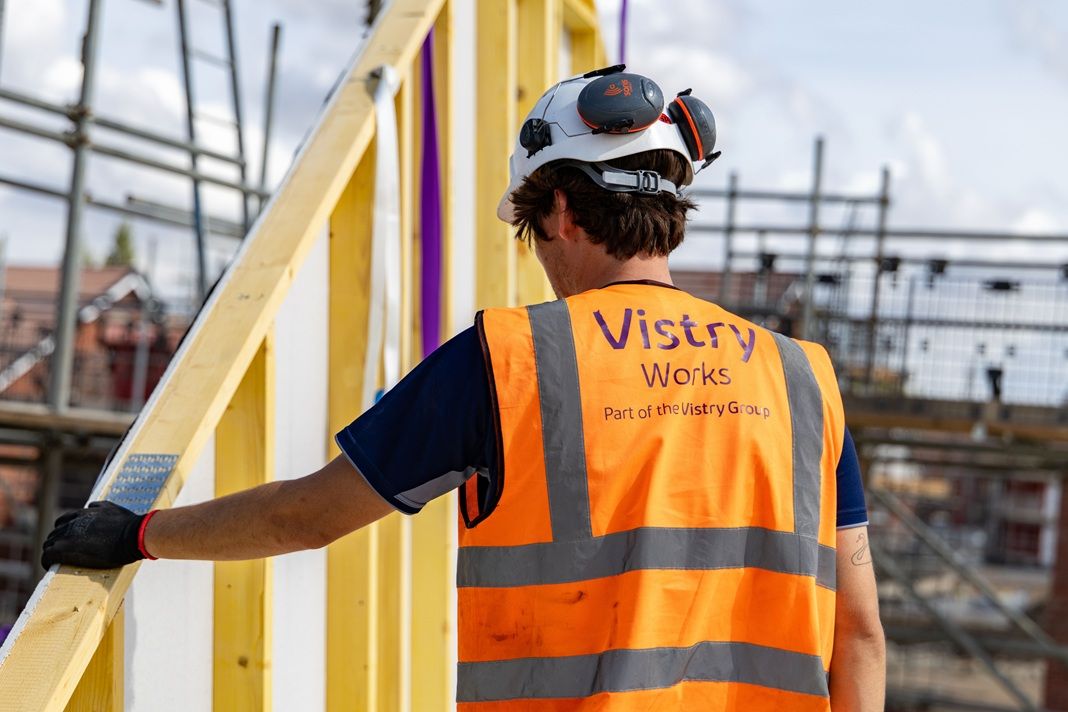
Vistry Works, the manufacturing arm of Vistry Group, operates three factories in Warrington, Leicester and the East Midlands. It is targeting capacity to support up to 6,000 homes per year.
Its timber-frame systems are manufactured off site before being assembled on developments. Vistry said this allows the timber frame of a new home to be erected in a day and made watertight in less than a week.
Jack Brayshaw, head of research and innovation at Vistry Group, said: “The challenge facing the industry isn’t simply whether there is enough demand or investment to build more homes. We also need the people and capacity to physically deliver them.
“Modern Methods of Construction allow us to manufacture more of a home in a controlled factory environment, reducing the amount of labour-intensive work needed on site and helping our skilled workforce become more productive.
“This isn’t about replacing traditional skills. It’s about complementing them, creating new skills and career opportunities and making sure a shortage of capacity doesn’t become a brake on the country’s housing ambitions.”
Factory-built construction also offers significant productivity benefits. Vistry said its timber-frame homes can be completed in approximately 18 weeks compared with around 27 weeks using traditional brick and block, a reduction of 33%.
By combining timber frames with Mauer brick panels, the company stated that it is aiming to reduce that further to around 16 weeks.
Adam Daniels, chief executive at Vistry Group, added: “The scale of the housing challenge means we cannot simply rely on doing more of what we have always done. We need to increase capacity and productivity at the same time as investing in the next generation of construction skills.
“MMC gives us an opportunity to do both. By combining factory manufacturing with the skills of our teams on site, we can build more efficiently, provide high-quality careers and apprenticeships and ultimately deliver more affordable homes.”